“Trends in the economy, demographics, technology, communications, and even how we spend our leisure time, can affect the core capacities needed by every charitable nonprofit to be effective and sustainable.
It is our hope that by shining a light on nonprofit trends, those who lead charitable nonprofits, as well as those who invest in their missions, will be armed with information useful for decision making and planning for the future.”
– See more at: https://www.councilofnonprofits.org/nonprofit-sector-trends#sthash.Lot9vsos.dpuf
Storytelling Techniques for Your Fundraising Success
Nonprofit storytelling can be a powerful tool to recruit and motivate donors. Even more than shocking statistics, a story can spur donors to help because it makes the cause real and elicits empathy from potential supporters.
Allison Gauss from Classy.org had some great tips to tap into the power of storytelling.
Components of a Fundraising Story
The Character (Protagonist)
It all starts with a character. The main character gives your donors someone to identify with and care about. This is who they hope for, worry about, fear for, and cheer for. Decide who your character is and put them front and center!
Details
Details are what make your character and story more reliable. Tell your audience something concrete about your character that they will remember.
Goals
What does your character need or want? Your character’s efforts to achieve this goal is what moves your story forward.
Conflict
What is standing in your character’s way?
Villain That Stands In Way
Portray the object standing in your character’s way as a villain. It doesn’t have to be a person, it just needs to be something that your donor can help defeat.
Action
Empower your donor to be part of the story by helping the character reach a happy ending. Tell them what your organization can do with their help.
Ending
End with impact! What have you accomplished together? What progress has your character made? Make it clear that the fight isn’t over and their donation is needed to keep going.
Storytelling strategies
Allison Gauss also gives us four ways to present a story to help donors connect with your cause and move them to action.
#1 – Introduce the main character
Choose just one individual. Donors are much more likely to act when given just one individual rather than groups.
Pro Tips
• Offer details like the individual’s name, location, and personal goals (get permission!)
• Let the individual do that talking. Their story will be more impactful when your character tells it in their own words.
• Use pictures or video of the person so your supporters can put a face with a name.
#2 – Begin with a startling fact or statistic
The shock factor is a sure way to get your audience’s attention.
Pro Tips
• Think outside the box for metrics or facts that are so unexpected they demand an explanation.
• Reveal the people and places behind the headlines. Once you have your donors’ attention, give them more details about the situation on the ground.
#3 – Immerse your audience in a moment of conflict
Tell your story in a heart rendering way that makes your donor feel compelled to help.
Pro Tips
• Be descriptive, not dramatic
• Give your audience details like sights, sounds, and smells and let those evoke emotion.
• It’s not enough to convey devastation, show donors what actions you are taking and how they can help.
#4 – Make your cause a quest
Show your donors what you are planning. Show them a timeline of how you are helping. Tell your donors that with them, you are almost at the happy ending.
Pro Tips
• Use a concrete goal, whether it is a cure or a fundraising milestone, to motivate your audience.
• Explain what problems you have solved along the way that make your long-term goals possible.
Do you watch Shark Tank? How do you think your best presentation would fare with Mr. Wonderful?
Learn some super successful presentation tips now! Want more?
https://www.tvinsider.com/98529/shark-tanks-kevin-oleary-gives-4-tips-on-how-to-succeed-with-the-sharks/
Your content is the key to your successful year-end appeal. By now, you’ve gathered your stories and created your plan. Use these tips to make sure you structure your content and present it in a way that is sure to yield great results.
Four quick tips to winning content and formatting
1. Keep shorter paragraphs
Shorter paragraphs are easier for your donors to scan for details that are important to them. Longer paragraphs will cause your donors to lose focus and interest.
2. Include a P.S.
If your reader reads nothing else, they will read the P.S. Save this area for an important call to action, deadline, or quote.
3. Get your CEO to sign the letter
Your CEO is the face of your organization. His or her signature will hammer home with your donors that this is important and that they are important.
4. Find the right image
Use an image that will steal their heart and let your donors know what will happen right now if they don’t participate. Think of your picture as a place your donor can swim to to be the hero of the story.
Four more tips to perfect your year-end appeal content.
Network for Good gives us four tips from the Wild Woman’s Guide to Fundraising.
Be present active and direct
Spark people into action. You want to strengthen verbs with an active voice and first person pronouns. Say things like: “Go on. Pick up the pen. Write a check.” Or: “This child is hungry now. You can help her now. Please give.”
Move your call to action front and center
Don’t save your call to action for the end of the appeal. Instead, pepper your request throughout the letter. Offer donors several moments to think about giving. If you are sending an email appeal, be sure to link those calls to action to your donate page.
Focus on the donor! This is all about the pronoun “you.” Use it throughout the appeal. Talk about how your donors have made the world a better place with this gift. Your donor is the hero of this story. This increases the odds that they’ll click the donate button or send you a check because you acknowledged their important role in your mission.
Avoid these three common formatting mistakes
Be sure you present your content in a way your donors can read it easily and take action.
1. Long unbroken paragraphs
2. Tiny font or hard to read fonts
3. Tight spacing between lines of text.
Six tips for how to grab your donor’s attention and make your case.
1. Increase your font size and don’t use any long paragraphs.
2. Turn a long paragraph into a bulleted list.
3. Spotlight key ideas or messages with a bold font or yellow highlighting.
4. Feature a quote in larger text from a person the donor is helping.
5. Use readable fonts for the body of your letter.
6. Make sure you include the P.S.
As you write your appeal, ask yourself: How does this look right now and is there anything I can do to make this easier for the donor to read and act on. The more you can improve, the greater results you will see for your cause!
Are YOU communicating Donor Love? Did you know they’re 5 Donor Love Languages and would you like to know what they are? Watch now as Blockbuster Fundraising addresses this subject with Development Directors.
Telling your organization’s STORY has never been more important! It’s up to you to grab attention, grab empathy, and grab heartfelt donor connection, sometimes in minutes! Want to know how? Watch now!
If you are looking for a successful example of crowdfunding using stellar storytelling, look no further than The Smithsonian’s campaign to “Save the Ruby Slippers!” The Smithsonian conducted this campaign to preserve Dorothy’s Red Shoes on Kickstarter in October 2016 and raised $300,000 in just a few days!!!
Of course, “Save the Ruby Slippers” is a great campaign because we can all relate to Dorothy’s shoes and what they mean to our childhood and our image of home. So what else can learn from The Smithsonian’s success?
What made this crowdfunding campaign a success?
They told us what would be involved in the conservation.
They told us why The Smithsonian needed us.
They answered questions about where their funding comes from.
They explained what was happening to the slippers.
They showed pictures of how they would be preserved.
They explained why it was important.
They told us what goes into the process of conservation.
They talked about the amount they needed and backed that goal up by explaining what was included in the budget and how much each item cost.
They talked about their own history.
They explained where the slippers would be displayed.
And, they thanked their donors. They thanked them for getting them to the goal and explained that the slippers would now be kept sparkling for future generations. They made sure that donors felt like team members who had accomplished a great success.
In this video, you will learn how a cohesive, powerful message with a sense of urgency can build your monthly giving program.
Extra Help: a guide to building a monthly giving program: http://info.kindful.com/monthly-giving-guide
If you find this fundraising tip useful, please SUBSCRIBE and SHARE!
Many thanks, Joy
P.S. Here’s more fun on the why’s of monthly giving https://www.youtube.com/watch?v=o_f1kM8soq0
NextAfter had a great webinar today that inspired me to immediately share some ideas with you right now for thanking your donors!
The bar has been set by one non-profit that sent 9 thank you’s in the first 90 days for one gift! Wow!
Wonder how and what they did? Watch and see.
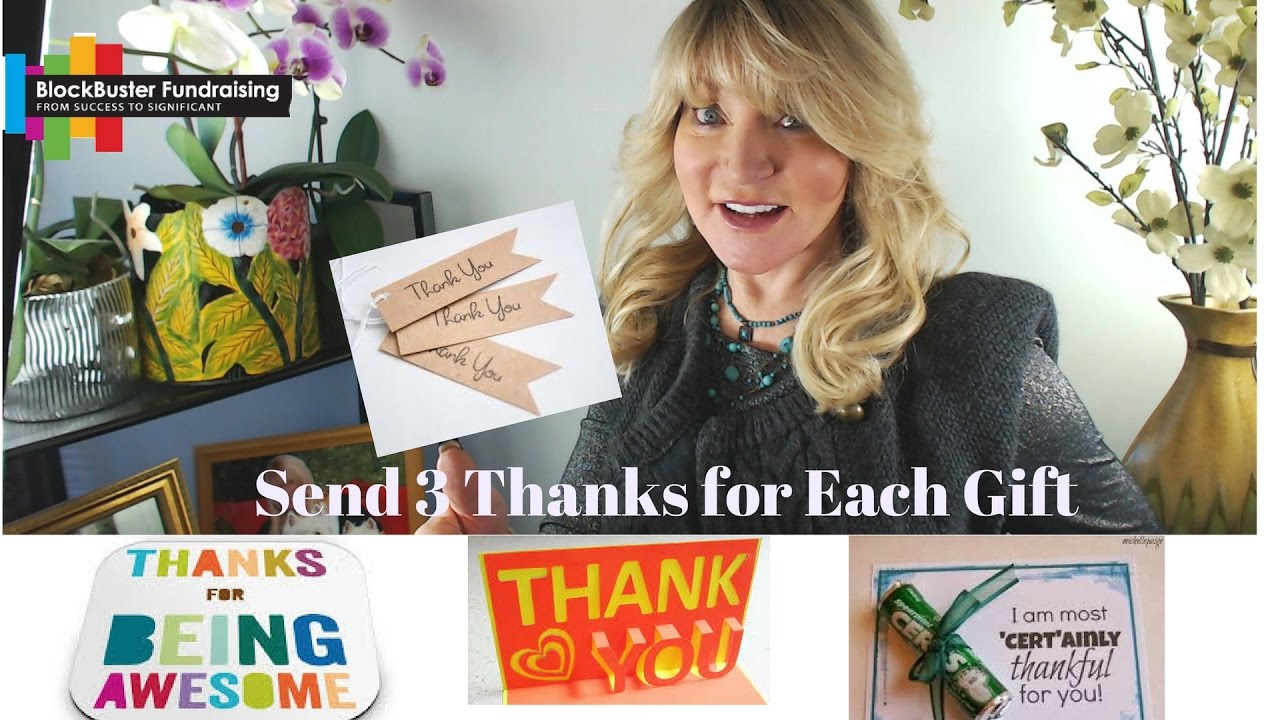
Your new thank you ‘best-practice’ should be 3 thank you’s for each gift! Your new continuum of thanking! www.nextafter.com
What are you 2017 fundraising resolutions?
How about Retention for a start?
And making more ASKS?
And reinforcing or revamping your Brand?
Go for it! 2017 is your year! Make it a Blockbuster Year! Stay tuned for lots of great ideas for your success!!
P.S. 5 Retention Tips here: http://nonprofithub.org/fundraising/donor-retention-5-ideas-to-get-donors-to-stick-around/
As Development peeps, we must make it a resolution to get out and meet with community thought leaders, the key mover and shakers in our region, with a well-prepared short passionate ‘who we are’ presentation!
They may never be your donor, they may never be your board member, but you do want them to know of the good you are doing now! Leave them with a good story, a good impression, and a desire to know more!
Would you believe that a single thank you note to a group of donors brought in an extra $450,000 to FOOD FOR THE POOR?
Watch now and see how Executive Director, Angel Aloma, did it!
Blockbuster Fundraising offers this as the first great 2017 Fundraising Tip for YOU! Watch this video and then read 20 QUESTIONS, THE DONOR COMMUNICATIONS TEST for more great tips and “AHA” moments!