Before I give my support to your cause or your new project, I must feel, understand, and believe the need. It has to be real, that it can be solved has to be believable. The story you present to me must create connection and emotion before I donate. Does your storytelling create a true sense of need, belief, and connection? These tips today will help!
Category: NonProfit Storytelling

Why Your Stories Matter Now More Than Ever Before
Storytelling or telling your very best stories has never mattered more! Share your best stories is every communication to build more rapport and connection with your donors. Here’s how!
https://youtu.be/mz5Yj4JxIJQ
DONATION PAGES THAT SHINE
Shining examples of best donation pages and changes you can make now to your non-profit donation page for year-end success
Rock Your Year-End Storytelling
Your non-profit story is your most valuable asset. Your heartfelt story will inspire action and create change. If you can tell your story like a feature movie, your donors will never forget it. And, even better, they’ll share it with others and you’ll be a rockstar.
Rock your storytelling! Your non-profit story is your most valuable asset. Your story can inspire action and create change. If you can tell your story like a feature movie, your donors will never forget it. And, even better, they’ll share it with others.
Important Story Components
A Character
Stories that draw people in are stories in which people care about, identify with or are fascinated by a character. You’ve got to put your characters front and center. Who is the person who needs your donor’s help?
A Hero
You need a hero. Ideally, this would be your donor!
A Threat
What is your donor saving your character from? What will happen without your donor’s help?
The Head and The Heart
You need to balance this combination. Don’t just give the facts and figures. To really tell a story well you have to be able to hold someone’s pain.
Top 10 Insights from the 2012 Nonprofit Technology Conference
#1 – The best stories are the ones that you remember. That move you to share and take action.
#2 – People will forget what you told them, they’ll forget what you did, but they’ll never forget how you made them feel through stories. Make your story about your case and the character who will be helped.
#3 – Your storytelling doesn’t have to live within your marketing team. Your donors can contribute by sharing.
#4 – Keep recording stories! Talk to your donors and other staff and figure out some great stories to tell.
#5 – Consider your medium. Tell stories in direct mail, email, and also in video form.
#6 – In your video stories, make sure to not just have talking heads and keep your video to 1-2 minutes.
#7 – Don’t forget, a story has a beginning, middle, and end.
#8 – Use an image to touch heartstrings.
#9 – Simple stories are the best.
#10 – Don’t be afraid to fail!
12 Year-End Fundraising Checklists
12 fundraising checklists that will take your year-end fundraising to huge heights so you’ll definitely want to review and check off each detail!
Blockbuster is all about bringing all the very best fundraising tips to one place where you can spend minutes a day, reviewing, refreshing and learning from the most excellent fundraising leaders globally available. Today’s Facebook LIVE presents 12 fundraising checklists that to be best you want to review and check off each detail! Save and watch in October so your plans are complete and completely super ready for fab 2017 success!
6 #GIVINGTUESDAY HACKS
October is the perfect time to review or begin or improve your 2017 #GivingTuesday campaign. Here are 6 #GivingTuesday Hacks just in time to jump-start great results.
#GivingTuesday Tips
What is #GivingTuesday? #GivingTuesday is a counterpoint to the consumerism of Black Friday and Cyber Monday. It started with just a few hundred nonprofits in 2012 and it has since blossomed into an international day of giving around the globe. In 2015, the total donations for the day were up to $116.4 million from $45.6 million a year before!
#GivingTuesday is the launch of your year-end giving season. It starts the energy and excitement to carry you through December 31st. Think of #GivingTuesday as an online kickoff.
1. #GivingTuesday Goals
Your giving Tuesday goals can be about more than just dollars raised. Here are some different goals to set:
• Number of donors
• Number of new donors
• Number of volunteers/hours (if you are including an activity)
• Number of recurring donors
• Percentage participation among key groups like staff, board, alumni, or clients
Set goals
It is imperative to have a clear goal that you, your team, and your supporters can rally around. If you had a #GivingTuesday campaign last year, you can use those results as a benchmark. Another great goal-setting tool is to use a giving pyramid. Map out what you will need to get to your goal. One or two donors at the top level with more donors at the lowest level.
2. This is a chance to tell fresh stories, attract new younger supporters, accelerate your social media presence or diversify your fundraising channels.
3. Make a plan
You need a concrete plan with goals and a calendar timeline. You won’t know if you’re on track without a detailed plan!
Inspire your donors to give
4. Use wonderful stories and an easy to use donation page with a prominent donate now button.
5. Show your gratitude
Have an instant thank you letter to send to your donors. Have a system in place to welcome new donors so they feel valued and appreciated right from the start.
6. Try a new idea
This is the perfect chance to try something new. Your #GivingTuesday goal will probably be a smaller one and you’ll be attracting lots of new donors, so this is your best opportunity of the year to try new ideas.
What Does Stock Market Record High Mean to Your Donor?
WHY YOU NEED TO ACT and REACH-OUT TO DONORS NOW!
With tax talk ramping up in Washington and a record-setting stock market, 2017 could be a good time for your donors to assess their personal financial and philanthropic goals to minimize their tax bill and maximize their charitable impact. Here are a few things to consider for your philanthropy in the second half of the year:
• If proposals to change the 100 year-old charitable tax deduction are enacted, donors charitable gifts may be more tax advantageous this year than in the future.
• There can be tax advantages to gifting appreciated securities and, more importantly, more funds available to donate to charity.
•many donors give impulsively throughout the year but now possibly could have the greatest charitable impact, to make fewer, larger gifts with causes that touch their heart.
Summer Stories Predict Sunny Fundraising Results
Storytelling Techniques for Your Fundraising Success
Nonprofit storytelling can be a powerful tool to recruit and motivate donors. Even more than shocking statistics, a story can spur donors to help because it makes the cause real and elicits empathy from potential supporters.
Allison Gauss from Classy.org had some great tips to tap into the power of storytelling.
Components of a Fundraising Story
The Character (Protagonist)
It all starts with a character. The main character gives your donors someone to identify with and care about. This is who they hope for, worry about, fear for, and cheer for. Decide who your character is and put them front and center!
Details
Details are what make your character and story more reliable. Tell your audience something concrete about your character that they will remember.
Goals
What does your character need or want? Your character’s efforts to achieve this goal is what moves your story forward.
Conflict
What is standing in your character’s way?
Villain That Stands In Way
Portray the object standing in your character’s way as a villain. It doesn’t have to be a person, it just needs to be something that your donor can help defeat.
Action
Empower your donor to be part of the story by helping the character reach a happy ending. Tell them what your organization can do with their help.
Ending
End with impact! What have you accomplished together? What progress has your character made? Make it clear that the fight isn’t over and their donation is needed to keep going.
Storytelling strategies
Allison Gauss also gives us four ways to present a story to help donors connect with your cause and move them to action.
#1 – Introduce the main character
Choose just one individual. Donors are much more likely to act when given just one individual rather than groups.
Pro Tips
• Offer details like the individual’s name, location, and personal goals (get permission!)
• Let the individual do that talking. Their story will be more impactful when your character tells it in their own words.
• Use pictures or video of the person so your supporters can put a face with a name.
#2 – Begin with a startling fact or statistic
The shock factor is a sure way to get your audience’s attention.
Pro Tips
• Think outside the box for metrics or facts that are so unexpected they demand an explanation.
• Reveal the people and places behind the headlines. Once you have your donors’ attention, give them more details about the situation on the ground.
#3 – Immerse your audience in a moment of conflict
Tell your story in a heart rendering way that makes your donor feel compelled to help.
Pro Tips
• Be descriptive, not dramatic
• Give your audience details like sights, sounds, and smells and let those evoke emotion.
• It’s not enough to convey devastation, show donors what actions you are taking and how they can help.
#4 – Make your cause a quest
Show your donors what you are planning. Show them a timeline of how you are helping. Tell your donors that with them, you are almost at the happy ending.
Pro Tips
• Use a concrete goal, whether it is a cure or a fundraising milestone, to motivate your audience.
• Explain what problems you have solved along the way that make your long-term goals possible.

Story Telling Techniques That Motivate Your Donors to Take Action
Telling your organization’s STORY has never been more important! It’s up to you to grab attention, grab empathy, and grab heartfelt donor connection, sometimes in minutes! Want to know how? Watch now!

Build Online Donor Relationships Now!
Online donor stewardship has never been more important in these competitive nonprofit times. John Haydon recently wrote some great tips for fundraisers that I think you will appreciate as much as I did.
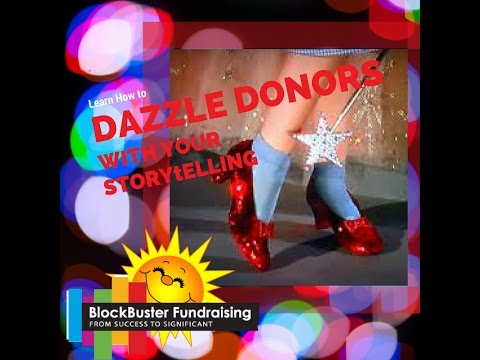
CrowdFunding Success With Dazzling Stories
Dazzling Storytelling Means Crowdfunding Success
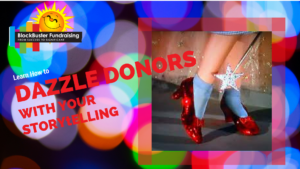
If you are looking for a successful example of crowdfunding using stellar storytelling, look no further than The Smithsonian’s campaign to “Save the Ruby Slippers!” The Smithsonian conducted this campaign to preserve Dorothy’s Red Shoes on Kickstarter in October 2016 and raised $300,000 in just a few days!!!
Of course, “Save the Ruby Slippers” is a great campaign because we can all relate to Dorothy’s shoes and what they mean to our childhood and our image of home. So what else can learn from The Smithsonian’s success?
What made this crowdfunding campaign a success?
- They told us what would be involved in the conservation.
- They told us why The Smithsonian needed us.
- They answered questions about where their funding comes from.
- They explained what was happening to the slippers.
- They showed pictures of how they would be preserved.
- They explained why it was important.
- They told us what goes into the process of conservation.
- They talked about the amount they needed and backed that goal up by explaining what was included in the budget and how much each item cost.
- They talked about their own history.
- They explained where the slippers would be displayed.
Did they stop when they reached their goal?
No!!
When the Smithsonian reached their $300,00 goal, they were ready to stretch the project. They announced they needed $85,000 to conserve and display the Scarecrow costume.
And, they thanked their donors. They thanked them for getting them to the goal and explained that the slippers would now be kept sparkling for future generations. They made sure that donors felt like team members who had accomplished a great success.

Storytelling Success Steps
